
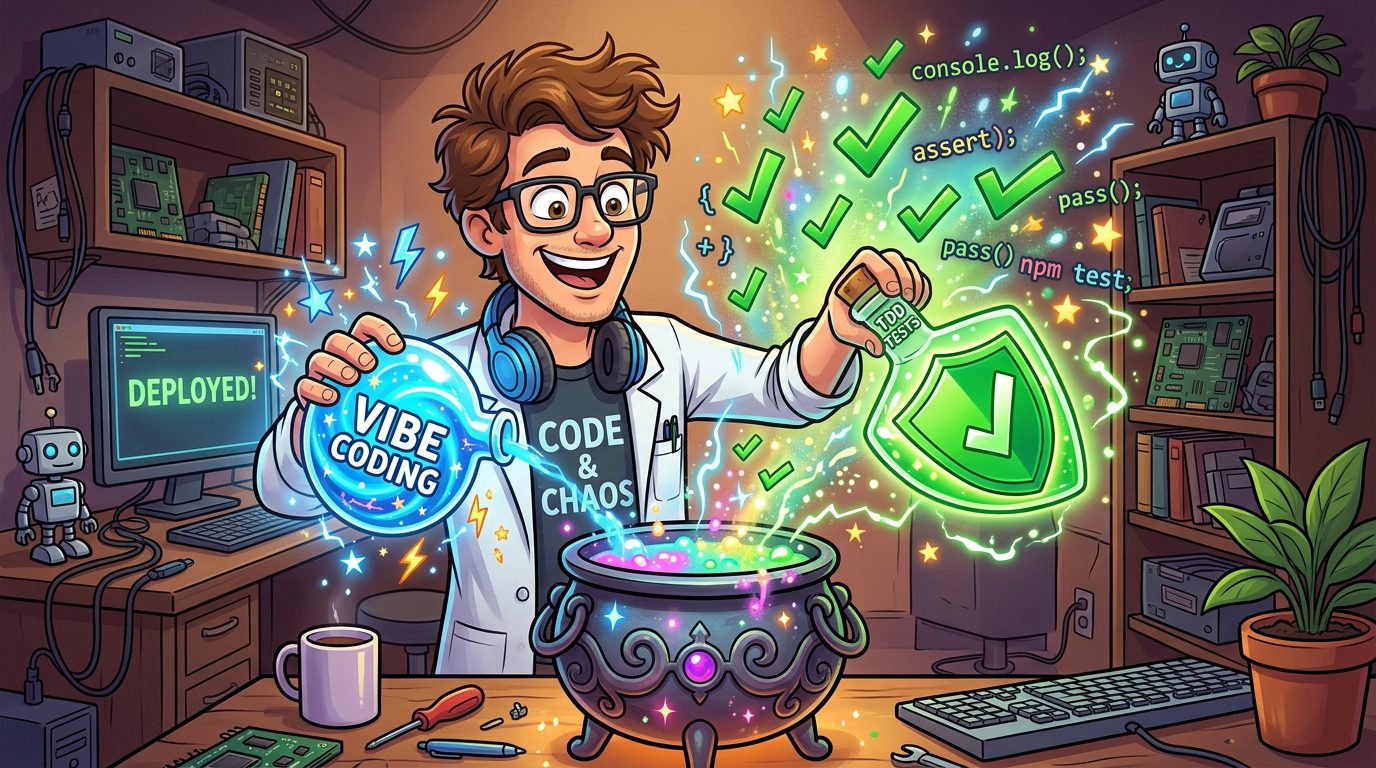
When "vibe coding" first took over developer social media, it felt like magic. You typed a loose description into an AI agent, watched hundreds of lines appear, and deployed within minutes. I know that feeling well. When I built this site with AI agents, vibe coding is what got the project off the ground.
But anyone who has taken a vibe-coded project past a quick prototype hits the same wall: regression debt. Without strict boundaries, vibe coding produces code that works great for five minutes, until you add the next feature and quietly break something that was already working. As we move through 2026, the honeymoon phase of unchecked vibe coding is ending, and the developers who thrive are pairing AI speed with an old discipline: test-driven development.
The illusion of "it compiles, so it works"
When an AI agent generates code, it writes with total confidence. The syntax is clean, the formatting is crisp, and it compiles without errors. But compilation is not correctness, and the gap between them is where the expensive bugs live.
Here is a real one from this site. I wrote a seeder to load some sample blog posts into the database. They showed up perfectly on the public site. Then I opened the admin panel to manage them, and the list was empty. The posts existed. The public page rendered them. The admin page insisted there were none.
The cause was a seam. My seeder wrote each post keyed one way, while the admin panel's list query looked for posts keyed a different way. The public page found them through a secondary index that happened to match, so it worked. The admin page queried the primary key directly, found nothing, and returned an empty list with no error. A row can be perfectly visible through one path and completely unreachable through another.
Every individual piece had passing tests. The seeder ran. The query ran. The handler returned a clean response. What nothing tested was the contract between writing a post and reading it back through both paths. That is the class of bug vibe coding produces constantly, and you cannot catch it by staring at code that looks correct, because it does look correct.
Flipping the flow: tests first, AI second
If catching these visually requires manually clicking through the app after every generation, you have not saved time. You have moved your labor from typing to manual QA, and that does not scale. Spend ten minutes hand-testing every time the AI produces thirty seconds of code, and you are losing.
Test-driven development flips the sequence. Instead of asking the agent to build a feature and hoping it broke nothing, you invert it:
Define the contract first. Write the tests, or have the agent write them, that state the expected inputs, outputs, and error states, including the seams. For the bug above, that means a test that writes a post and then asserts it is reachable through both the public and the admin read paths.
Run them and watch them fail (red). Confirm the tests fail for the right reason.
Point the agent at the tests (green). Direct it to write the implementation that makes the suite pass.
Refactor with a safety net. Let the AI clean things up, knowing any broken logic trips a red test immediately.
With a test-first flow, the agent is no longer guessing what "working" means. The tests are the contract, and the AI is just an engine that fulfills it.
Tests are guardrails for the agent
In my Go backend, clean package boundaries and a real test suite are the only reason I can let an agent refactor across many files without it turning into chaos. The suite does three things for AI work specifically.
It gives instant feedback. When an agent edits a dozen files, go test ./... finishes in a couple of seconds and tells me immediately whether a side effect slipped in. That two-second loop is what makes autonomous refactoring safe instead of terrifying.
It is token-efficient. When a test fails, I do not write a long explanatory prompt. I paste the exact failure output back to the agent, which gives it a precise target instead of a vague complaint. The regression I described earlier now has a permanent guard test asserting that a created post is reachable through both read paths, so that specific seam can never silently break again.
And it gives me the confidence to ship. I stopped being afraid of my own codebase. I can hand the AI a major refactor because the suite guarantees the system still holds together, and I trust the green far more than I trust the generated code on its own.
Vibe coding did not die, it grew up
Vibe coding is not going away, but it is maturing. Throwing a vague prompt at a model and hoping for the best is being replaced by structured, test-driven engineering. AI gives us real speed, but speed without direction is just a faster way to build tech debt, and the seeded-content bug was mine proving that to myself.
Put the tests in front of the AI instead of behind it, and you get both halves: the speed of automation and the reliability that comes from a machine that only counts a feature done when the contract passes.