
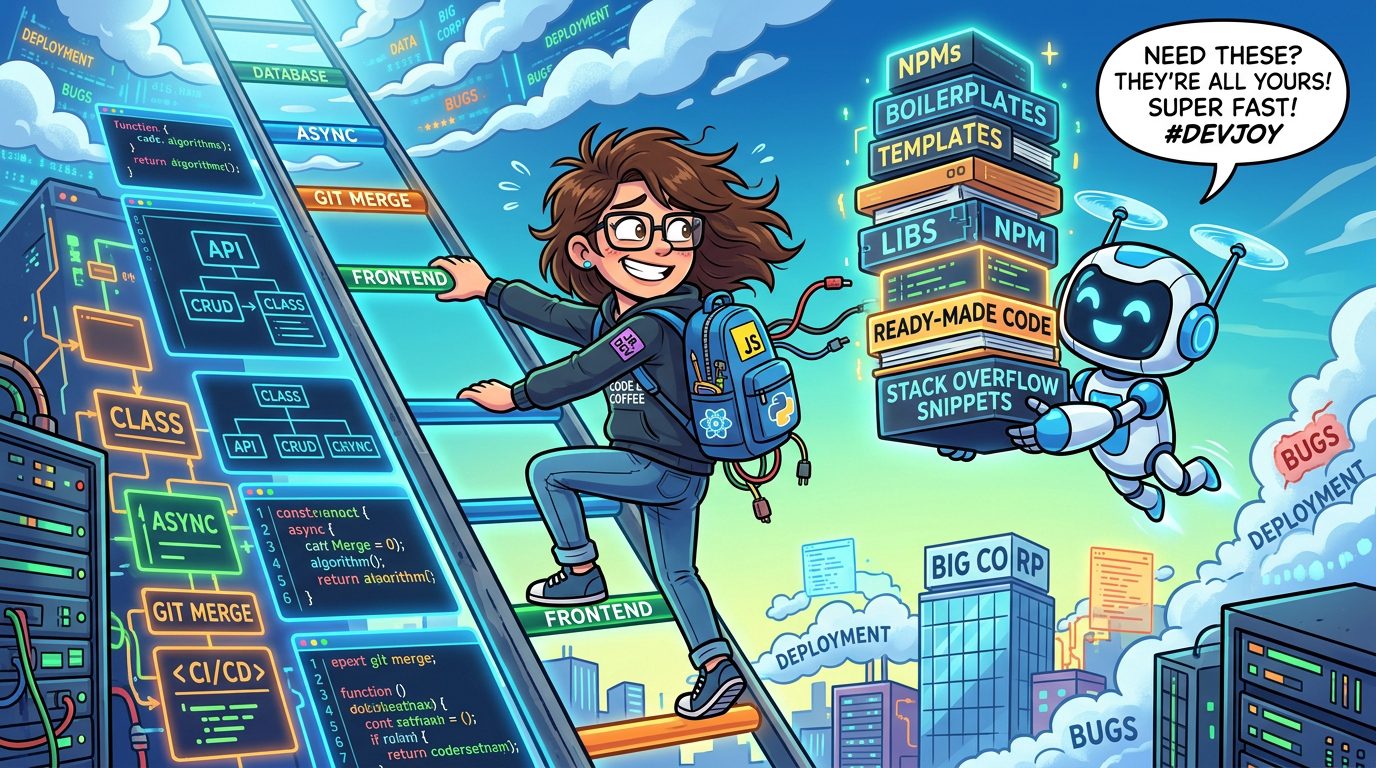
The narrative going around this month is tidy. AI squeezes out junior developers who write routine code, while senior engineers who design and validate AI-driven systems enter a golden era. It gets repeated because half of it is true. The other half misunderstands what a junior developer was ever for.
I build my own site end to end. A Go API, a React frontend, the AWS infrastructure under it, the CI pipeline, the security hardening, all of it solo. So I have spent a lot of time being every level of engineer at once, including the junior one fumbling through something for the first time. That is the seat I am writing this from.
The part that is true
Writing routine code is getting automated, and there is no use pretending otherwise. Boilerplate, the tenth CRUD endpoint, the form validation you have written a hundred times, a first-draft test suite. AI is genuinely good at this now, and it is only getting better. If your value to a team was that you could be handed a small, well-defined ticket and turn it into working code, that specific value is dropping. Fast. That is real, and telling people otherwise does them no favors.
The part that is nonsense
Here is what the tidy version gets wrong. Nobody was ever paying a junior developer for the code they typed. They were paying for the senior that junior would become in two years. The typing was never the point. It was the way you learned.
You do not become someone who "designs and validates AI-driven systems" by starting there. You get there by building small things, breaking them, debugging at 1 a.m., and slowly forming a real model of how software actually behaves. Validating an agent's output is a senior skill precisely because it requires knowing what wrong looks like, and you only learn that by having been wrong yourself, many times.
So the danger is not that AI replaces juniors. The danger is that if teams stop hiring and training juniors because AI covers the routine work, we quietly stop producing the seniors everyone suddenly says are precious. You cannot have a golden age of senior engineers and also remove the ladder they climbed.
Where knowing what "wrong" looks like paid off
Let me make this concrete, because it is easy to hand-wave. At one point the login system on my site started returning a server error when someone tried to refresh an expired session for a user that no longer existed. The AI-generated handler looked completely reasonable. It decided whether a failure was the user's fault or the server's by checking the error message text for words like "invalid" or "expired." A missing user matched neither, so it fell through and reported a 500, as if the server had crashed.
That is exactly the kind of code that passes a casual glance. It runs, it compiles, it handles the common cases. But a session that cannot be re-established is not a server crash, it is an authentication failure, and it should return a 401. And classifying errors by pattern-matching their English text is fragile in a way that will bite you later. Knowing both of those things is not something the agent supplied. It came from having debugged auth flows before and having been burned by string-matched error handling in the past. The fix was small. Recognizing it was needed at all is the whole job.
What I would actually tell someone starting out
Use AI, obviously. It would be strange advice to ignore the most useful tool that has ever landed on our desks. But use it the way a senior would, not the way a shortcut-taker would.
Here is the difference. Let it write the boilerplate, then read every line and make sure you understand why it works. Ask it to explain the parts you do not follow, then go verify the explanation against the docs, because it will sometimes be confidently wrong. Use it to move faster through the boring parts so you have more time for the hard parts, not to skip the hard parts entirely.
And build whole things. This is the one I feel most strongly about. Building my site solo taught me more than any single job task could, because I had nowhere to hide. When the deploy broke, that was mine. When the login needed protecting against brute-force guessing, I was the one who had to add the throttling and think through how to lock out an attacker without locking out myself. When the page rendered blank in the browser while every test passed green, I had to actually understand why. You cannot delegate that understanding to an agent and still end up with it in your head. The understanding is the product. The code is just the receipt.
The honest bottom line
The engineers who do well from here are not the ones who prompt the fastest. They are the ones who understand their systems deeply enough to know when the machine is lying to them. That has always been the job. AI just raised the price of not knowing.
If you are starting out and this all sounds discouraging, flip it. The barrier to building a real, complete, working thing has never been lower. So go build one. Ship it. Break it. Fix it in public. That is still how you become the kind of engineer nobody is worried about replacing.